

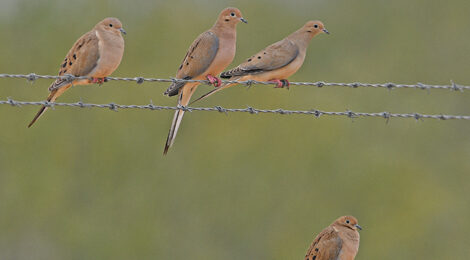
Dove Hunting — A Texas Tradition
September is prime time to test one’s shotgun skills that offers a generous bag limit and plenty of fast flying targets.
Story and photography by Bob Zaiglin
As I work on this article in early July, the welcomed and therapeutic sound of raindrops hitting the roof of my home office makes me feel a little more optimistic about the dove season Texans will enjoy come this fall. No question about it, rainfall is the primary catalyst when it comes to the development of flourishing wildlife populations. It not only augments the regeneration of the various brush species containing the crude protein level required to satisfy the nutritional demands of white-tail deer and various exotic hoof stock, it also stimulates the establishment of a lush and diverse ground layer composed of a variety of seed-bearing grasses important to sustaining dove and quail populations. Rainfall also benefits the habitat for a variety of insects, representing protein for young birds.
As everyone knows, a prolonged drought has gripped South and Central Texas over the last few years, and dove and quail populations have suffered. One of the counties severely impacted by the lack of rainfall, Kerr County, was hit by a devastating storm throughout the predawn hours of July 4th, unleashing a 30-foot rise of the Guadalupe River, obviously putting an end to the drought, but tragic to many of the county residents and their visitors.
Other portions of the state have realized some relief as rainfall, although scattered, has occurred and should have benefitted nesting birds. Texas dove hunters should experience a good, not great, season, but one must remember a good season in Texas would be considered outstanding in most other states.
Based on the amplitude of white-wings calling from and around their nests throughout the town of Uvalde on my early morning walks, I have heard what I consider an average number of nesting birds in May, but with several rain showers in June, the sound of nesting white-wings intensified significantly, indicating that additional birds were nesting, and more importantly a number of them were nesting for a second time, which could mean additional birds this fall.
************************************************************************
To read more, click here to SUBSCRIBE