


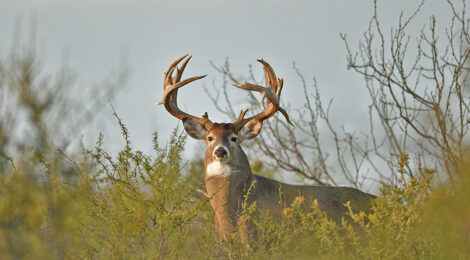
INVINCIBLE BUCKS
Whether it’s a response to man or an inherent behavior, the older they get, the harder they are to locate.
Story and photography by Bob Zaiglin
Mature bucks are challenging to see early in the hunting season, particularly in the brush country where unseasonably warm temperatures suppress older buck activity. But as days grow shorter and temperatures drop in December, mature bucks, fired up on testosterone, become active.
Young bucks are observed quite often early in the season because they are not only abundant, but curious. Because of their curiosity, some fawns and yearling bucks will succumb to natural causes. On the doe hunts I conduct for management purposes, I often recommend that antlerless deer demonstrating little or no fear of man be allowed to walk because fawns, exhibiting little fear of man, and exercising a curious behavior, generally turn out to be bucks.
The principal reason young males are prevalent in the fall is because they make up the highest percentage of the buck population. Combined with their inherent curiosity, they become vulnerable.
A mature buck is a different animal. Once a buck reaches its fifth year, a significant behavioral change occurs. Seldom are they observed outside the rut. Just what is it that makes older deer behave in such a way?
The answer would be simple if we were talking about intensively hunted public land where bucks must escape detection by becoming elusive and reclusive over time just to survive. Bucks surviving five or more hunting seasons on intensively hunted lands are forced to become reclusive, but I have witnessed the same behavior on lightly hunted areas as well.
************************************************************************
To read more, click here to SUBSCRIBE